Saturday, February 22, 2014

Old Mutare Mission Hospital

Old Mutare Mission was our first stop to see what the United Methodist Church is doing to help people in Zimbabwe.  It is called Old Mutare because the site of the mission was the original location for the town of Mutare, but the actual city was moved when the supplies needed to build the town couldn't be hauled over the mountains from Mozambique.  The area was given to a missionary and ever since has belonged to the Methodist Church in Zimbabwe for mission work.  It is a large area and holds many different buildings and programs.  We were fortunate to visit many of these while there.
 
Our first stop was the Old Mutare Waiting Mothers Shelter.  We met 16 women in their last weeks of pregnancy.  They come to live at the Waiting Mothers Shelter so they can be close to a hospital when they give birth to receive good medical assistance and eliminate problems that can be deadly when delivering a baby in more remote areas of the country.  They were very happy to take photos with us and let us see their temporary housing.  Their make-do shelter has no toilets or water nearby, no electricity and no kitchen for cooking food yet they still stay there for their babies safe deliveries.  The head nurse that gave us our tour let us know that they would very much like to provide a kitchen for these mothers to cook their own food and have electricity for a fridge so they can store extra food that they cook.  As you can see in the photo below they have lanterns they can use that are solar powered.


Next we toured the Old Mutare Hospital right next door.  There was an unbelievably long line of people waiting to be seen by one of two doctors.  The doctors that work here are truly a gift from God working long days helping people who have walked many miles to receive medical care.  The biggest challenge for these doctors is not having enough electricity to keep the pumps running to provide water from their bore holes during the day.


Next we were able to visit the maternity ward and see 2 and 3 day old babies and their mothers who graciously allowed some of our team members to hold the cute little babies.  Loree and Annette couldn't resist the urge to hold these new little bundles of joy!


Next it was time for us to listen to a talk on maternal health from a female doctor who is an Ob/Gyn and has helped her fellow Zimbabwean women deliver babies for years.  She brought us up to speed on the challenges she has faced daily in helping women during their pregnancies.  There are many barriers to a successful delivery and some of those are lack of funds to pay clinic fees, midwives and nurses not trained to spot pregnancy complications early on, lack of transportation to get to a clinic or hospital when a delivery becomes problematic, etc.  She has seen too many women and babies die due to complications that could have been prevented early on.  The current nurses in Zimbabwe are paid very little and overworked with too many patients for each nurse.  She is advocating for a better salary and benefits for nurses to keep them from going and working in neighboring countries and keep more around so their are fewer patients to each nurse.  She is also advocating more training for midwives to spot high risk pregnancies early on and inform the mothers the options they have available to them to make sure they can be in a hospital facility that can assist them with a safe delivery.  She was very passionate and knowledgeable and helped us understand why the life expectantcy rate is so low in Zimbabwe.  There are too many women and babies dying during childbirth. 
 
We also received some insight into the AIDS/HIV crisis in Zimbabwe from this doctor.  Fortunately, people are no longer being quiet about HIV and how it spreads so they have seen the number of infected people going down.  However, in this country's culture the man is the head of the household and the group of people that are still being infected are married men and women.  This is mostly due to infidelity in a marriage.  If a wife suspects that her husband is having intercourse with someone else she can ask her husband to wear a condom during sex, but if he says no then she must have sex with him without a condom and risk becoming infected.
 
After this informative discussion we got to visit the Tairo Project.  The Methodist Church trains people who have HIV to sew and make items such as bags, purses, bookmarks, wall hangings, clothing, etc that they can sell in order to support themselves and their families.  We met a man who had been trained and was using their hand crank sewing machine to sew some items.  Some of us took advantage of our first opportunity to shop and buy local made items that would support our church's mission.


The mission hospital also had vegetable gardens, a dental clinic and so much more.  It was humbling to see all the good work being done by the Zimbabwe Methodist Church in Old Mutare.  They are helping so many people in so many different ways.  


Coming Home

Well it's hard to believe that our Zimbabwean journey is over.  We had a very meaningful trip learning about the health of women and children in Zimbabwe as well as a cultural exchange with fellow UMW sisters who live in Zimbabwe.  We had a team that was truly hand picked by God and we are now sisters bonded for life.  We heard beautiful music and were inspired by the green and rocky scenery that we encountered.  We saw a country of people who help each other and do any kind of work they can to make enough money to feed their children and send them to school.  Education is very important to the people of Zimbabwe and the majority of people can read with a higher literacy rate than here in the USA.  I know I was also impressed that access to education was the same for boys and girls and many mothers work outside the home. 

Zimbabwe is a beautiful and peaceful country.  The people living there have a deep faith and trust in God.  But they don't sit around and wait for God to drop food, water, etc into their hands.  They are busy doing what they can to improve the lives of their children, but they also know when to relax and enjoy a cup of tea with a friend and savor the blessings of each day.  At times it almost felt like they don't need us Americans to come in and try to help, they are doing it for themselves.  We did see definite needs and ways we can help and I know many of us hope to go back again someday.

Well now that I've recovered from my jet lag I will be able to post lots of the photos we took on our trip so that you can experience for yourself part of what we found so amazing in Zimbabwe.

Thursday, February 13, 2014

On the Road Again

The past few days have been extremely busy, but very meaningful for our Ubuntu team.  We can't express how much we've learned from our Zimbabwe sisters and each other.  Below is a brief overview of what we've been doing.  Our internet access has been limited or slow and it's been challenging to load photos and put out posts.  I will share more details after our trip.

Monday was a day filled with many activities in Mutare.  We were able to see the Old Mutare Mission Hospital and the Waiting Mothers Shelter there.  We also visited the Fairfield Orphanage and then ended our day with a learning exchange with our fellow United Methodist Women in Old Mutare. Tuesday we toured around Africa University and then we were back on the road again to return to Harare and our host families. 

Wednesday it was back in the group van for our drive to Nyadire Mission.  The last hour of our drive to the mission was a dirt road that had many large ruts from the recent rains.  But it was great to see the rural areas of Zimbabwe along the drive.  Plus along the ride there were no bathrooms to use so we finally had to stop and go alongside the road in the bushes.  This just added to our African adventure!

There was so much to see and learn in Nyadire and we only saw a small piece of the puzzle.  We met with the heads of the various programs at the mission to hear the challenges they face and the needs they have.  Then we toured the Nyadire hospital, their Waiting Mothers Shelter and their orphanage.  Then we were back in the bus headed back to Harare just before the rain came down.

Today we met with the Bishop and had a debriefing, followed by lunch and some local shopping.  Everyday has been go, go, go and it was nice to stay in Harare today.  Tonight we will be hosting a dinner to thank our host families for taking care of us this week.  Tomorrow we look forward to seeing some programs here in Harare.  Saturday we will then depart for our personal travel part of the journey and head to Victoria Falls to see the second largest waterfall in the world.

All of our group members feel extremely proud to be United Methodist's after seeing the good work being done here in Zimbabwe.  Those of you back home should be prepared for us to come back with a passion for helping further the resources and programs that we have seen.  Thank you for supporting us in our calling to be a part of this trip.  We wish we had more time here to see and do more, but we are excited to return home and share our journey with all of our friends and family back home!

Sunday, February 9, 2014

Arrival in Zimbabwe

Our entire team made it safely to Harare, Zimbabwe yesterday after we all traveled via planes, buses, cars and across oceans and continents.  We were warmly welcomed by the local United Methodist host team and then spent time getting oriented to our mission and getting to know one another.  Our eight member team was divided into 4 host families and we all enjoyed a lovely meal at our host homes.  Thankfully they understood our need to rest and recover from the two days of traveling and allowed us an early night to rest up for our big week ahead.

Today we attended church with our host families and were warmly welcomed by their congregations.  We heard beautiful, soulful music by their church choirs followed by a thought provoking sermon.  Then it was time to hit the road again and travel by van to Mutare where we will be the next day and a half.  So far we have had a great time getting to know each other and learn about the culture of Zimbabwe.  The weather is perfect!  Nice and warm with evening showers and a cool breeze for sleeping.  Every thing is very green and we definitely don't miss the snow (at least not those of us from the midwest)!

Lunch at "Half-Way House" midway between Harare and Mutare

We look forward to meeting the women and children in Mutare tomorrow and can't wait to share everything we experience with all of you back home.

Monday, February 3, 2014

Meet Team Member Donna Akuamoah


Donna Akuamoah is from Ghana, West Africa, and she is the last child in a family of 6 children. She completed her primary and secondary education in Ghana, after which she was fortunate to receive a full four-year scholarship to attend Claflin University, a United Methodist affiliated college in South Carolina. She graduated with a Bachelor’s Degree in English and a double minor in French and History in 2008. She then went on to study law at Duke University, and graduated with a Juris Doctor degree in September of 2011. Her career goal is to serve as an international human rights advocate on behalf of women and children in Africa. She is currently Executive Secretary for International Ministries at the United Methodist Women National Office.

HIV/AIDS in Zimbabwe

Here is a YouTube video about the HIV/AIDS epidemic in Zimbabwe where 25% of the population has HIV or AIDS.  Watch it to better understand why.


Sunday, February 2, 2014

Meet Team Member Mary Jane Chapman


I am Mary Jane Chapman from Glen Ellyn, IL, and I am eager to make this journey.
I was raised in a small rural community in northern Indiana. I grew up on a farm.  From the time I was a very small child I attended the Methodist Church in that community.
I attended college at Indiana University and there met my husband. After we finished college my husband served in the military and during that time our two children were born. Both of these children now live nearby in the Chicago area, and I get to see them and my six grandchildren often.
For a time, I taught English at the local junior college and did some substitute teaching in the area high schools.  But I decided to change careers and went off to law school.  Since graduating from DePaul University College of Law, now 30 years ago, I have been a practicing attorney.  Currently I am in-counsel counsel for a real estate company.
I have served on a number of civic boards and commissions in my community. I was a board member for the non-profit organization that operates the battered women’s shelters in my county.  I was also a member of the Board of Trustees for the village in which I live. Currently, I serve on the Board of Trustees of my Methodist church here in Glen Ellyn and have been on this board for about 6 years.  Many of you may know that it is the trustees of the church who maintain and repair the church’s facilities.  My church has two parsonages and the church building. So there is plenty to fix, repair and maintain.
I have known our leader, Jane Dunn, for many years and know that we are all in very capable hands for this trip.  I will truly enjoy this Ubuntu journey and hope I can add to its success.


Meet Team Member Sarah Annette Pollard


I have lived in Myrtle Beach, South Carolina, most of my life.  I have a Bachelor’s degree in Secondary Education and a Master’s of Education in Elementary School Counseling.  I married Al Pollard who grew up in Ohio and had chosen a career in the United States Air Force; he died in 2009.  I have three adult children and three superior grandchildren.
 
                While we were traveling with the USAF, I chose to be a stay at home mom, and just substitute in the local schools.  When we settled back here, I taught for several years in a private Christian School.  Then I began my career as an Elementary School Guidance Counselor, a position that I considered more of a ministry than a job.  I retired in 2002.
 
            My faith and my church have always played a major role in my life.  I am a member of the church that I grew up in.  At that time, it was a “family” church and we all knew each other.  Now it’s 500 percent larger and most of the members are from somewhere else.  In my local church, I have a variety of responsibilities and participate in community ministries that we sponsor.  On the district level, I’m active in the United Methodist Women and Lay Servant Ministry.  I became interested in mission work when a pastor was assigned to our church and started leading mission trips; both Al and I went together on these trips. Curiosity got me involved, but love for and admiration of the people that we served captured my heart.   They have expanded my concept of mission and contributed to my personal spiritual growth in ways that I could never have imagined.


Tuesday, January 28, 2014

Presents for our Zimbabwe UMW Sisters

 
Click on this link to see some gifts made for the women we will be meeting in Zimbabwe.


Meet Team Member Shirley Ferrill

Shirley was born and raised in Wisconsin.  After graduating from high school in 1954 she joined the U.S. Navy.  Boot camp was in Bainbridge, MD; Class A Teleype School in San Diego and duty at Naval Communications Station in San Francisco. 

It was there she met a sailor, Joe Ferrill, and they were married in 1957.  He was transferred to the Philippines and in order for Shirley to go there, she had to take a discharge.  They spent 18 months in the Philippines, then to Norfolk, VA,  Alameda, CA and finally San Diego  They had three children along the way.  Joe retired from the Navy in 1969, and with three kids in school, they stayed where they were. Joe died in 1992.

Shirley was a stay at home mom and Navy wife for a number of years and then were to work for the local church and was the Administrative Secretary for 12 years.  From there she went on the the United Methodist Urban Miniistry Agency for San Diego District and spent 22 1/2 years with them. Her position Local Church Laison, but she also served as case manage, volunteer coordinator and edited a newsletter. 

She retired in 2002 and since then she stays busy with involvements in Veterans organization, United Methodist Women and several agencies where she served on the Board of Directors.  Her interests are reading, movies, theater and politics and traveling.

Her family of three children, four adult grandchildren and a brother and family are all in San Diego and are an important part of her life.  

Sunday, January 12, 2014

Meet Team Member Loree Nicholas

Hi, my name is Loree Nicholas and I am one of the team members for the 2014 Zimbabwe Ubuntu mission trip. I currently reside in Carol Stream, IL.   I am married with two daughters ages 21 and 22.  I have been in private practice since 1988 as a general dentist in Glen Ellyn, IL. Prior to dental school I received my certification as an expanded function dental assistant in 1978  from University of IL and have been in this field ever since. In the earlier years after my graduation from Northwestern University Dental School I frequently went to the local grammar schools to talk about oral health and proper technique to clean your mouth and the impact that your mouth has on your overall health.  I did that for approximately 10 years and it was a true joy working with the children.  My own children after that took up much of my spare time.


My career has given me so many wonderful opportunities to expand myself in ways that I never dreamed of.  Through extensive continuing education I have been able to travel to many parts of the world and experience the cultures and love that so many people have to offer.  It has and will continue to be a humbling experience to see how the other side of the world lives.


I have been on two previous medical mission trips through the United Methodist Volunteers in Mission working both times in Panama with our devoted leader Jane Dunn. Both trips were amazing!  When the invitation to join in on this group effort to Zimbabwe was offered I did not hesitate to say a hearty "yes please"!  I am so looking forward to meeting our team... working together to help in whatever ways that we can to interact, help, share, laugh, cry and empower the women and children that we will be working together with.  We have all been given many responsibilities to share and one of mine is as the team medic ....I will surely strive to keep my gal pals healthy.

 
Below are a few photos of me working in Panama, taking a hike at The Great Wall with The University of the Pacific Continuing Education Group, and a photo amidst the lovely wooded orchards of Door County Wisconsin.  Thanks everyone and wish us well.


Sunday, November 24, 2013

Meet Team Member Diana Smith from Iowa


My name is Diana Smith, one of the team members and blog master for the 2014 Zimbabwe Ubuntu mission experience.  I live in Des Moines, Iowa.  I am a lifelong United Methodist and am a member of the West Des Moines United Methodist Church.  I enjoy traveling and learning about other cultures and countries, especially in a mission capacity.  I have participated on several mission opportunities in the past.  In July of 2012 I was an adult chaperone for our church's youth mission trip to Colorado for the Week of Hope mission experience where my team worked at a senior assisted living facility.  In 2007 I spent four months in Guatemala as an individual Volunteer In Mission (VIM) through the United Methodist Church.  I volunteered at a low-income daycare facility in the mornings and taught English to elementary aged children at the local Methodist church in the afternoons.  In 2006 I was part of my church's mission work trip to Buffalo, New York.
 
Through my church I have also been involved in many programs and ministries.  I currently sing on our Praise Team and help lead our contemporary worship service as well as co-leading our young adult small group.  In the past I have taught children's Sunday School and English as a Second Language to adults.  I was a co-chair of our missions committee, volunteered with vacation Bible school, sang in the choir, participated in small groups and local service projects.
 
I currently work for the State of Iowa at the economic development department as the trade show coordinator on the marketing and communications team.  Before joining the IEDA, I worked for Children and Families of Iowa at the domestic violence shelter, where I coordinated donations for the families using our services as well as facilitated staff trainings and gave community presentations to raise awareness about domestic violence. 
 
I am a recent breast cancer survivor, having been diagnosed in October of 2012 and I finished my last treatment in July of 2013.  I am now cancer free and thankful that God isn't done with me yet.  I am a strong, quiet individual who is very passionate about my faith and women's issues around the world.  I enjoy history, traveling, practicing speaking Spanish, gardening, reading, music, spending time with family and friends, volunteering at church and helping people.  I have never been to Africa and I am very much looking forward to this trip to learn about the women of Zimbabwe and their lack of healthcare and how we can help.  I hope this is the first of many international team mission trips I will be involved with and someday I hope to be a team leader of one of these trips.
 
I have one cat, Chloe, who provides me with daily enjoyment.  I have two wonderful parents and one younger brother plus many more family members and friends.  Below are pictures of me from my time volunteering in Guatemala.


Meet our Team Leader


I am Jane Dunn and am privileged to participate in the Ubuntu Zimbabwe Journey as leader.  I am a life-long Methodist/United Methodist.  My husband Richard and I have enjoyed 25 or more United Methodist Volunteer-in-Mission experiences to Panama, Honduras, Guatemala, Cambodia, Senegal, Chile, Belize and to disaster areas within the United States.
 

We have 3 adult children.  Two sons live in the Portland, Oregon area with their families and a daughter resides with her family in Palm Beach Gardens, Florida.  We are the proud grandparents of  5 grandchildren ranging in age from 8 to 16.


I have a masters degree in Nursing.  My background includes experience as a hospital staff nurse, clinic work, a hospital service line manager and Assistant Professor at Lewis University School of Nursing’s Baccalaureate Program.  I am retired from full-time work but for the past 5 years have served as Consultant to the United Methodist General Board of Global Ministries as Manager of a Blog for Health Volunteers at www.umvim4health.blogspot.com .


While on an UMVIM experience in Cambodia, a United Methodist Medical Missionary Nurse named Irene Mparutsa served as one of our hosts.  Irene showed me the work she was doing regarding Community Health.  Irene is originally from Zimbabwe, is now retired and has returned home.  She will be volunteering to help host our group in February when we visit Zimbabwe. Pictured below is a photo of Irene and me during the Cambodia visit in 2007.


Thursday, November 21, 2013

Zimbabwe Background Info


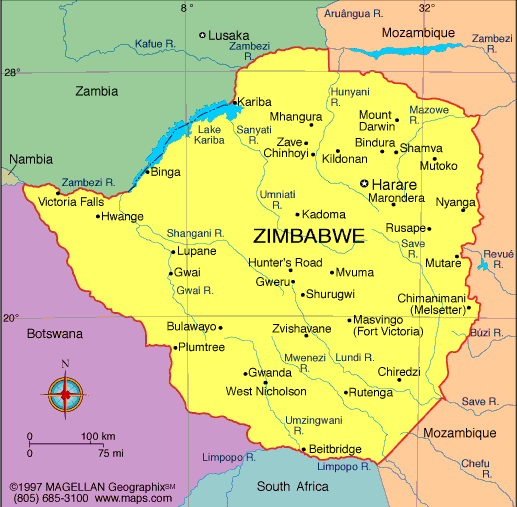
Zimbabwe /zɪmˈbɑːbweɪ/, officially the Republic of Zimbabwe, is a landlocked country located in southern Africa, between the Zambezi and Limpopo rivers. It is bordered by South Africa to the south, Botswana to the southwest, Zambia to the northwest and Mozambique to the east. The capital is Harare. Zimbabwe achieved de jure sovereignty from the United Kingdom in April 1980, following 14 years as an unrecognized state under the conservative white minority government of Rhodesia, which unilaterally declared independence in 1965.

Zimbabwe has 16 official languages with English, Shona and Ndebele being most common. The present territory was first demarcated by Cecil Rhodes of the British South Africa Company, becoming a self-governing colony as Southern Rhodesia in 1923. President Robert Mugabe is head of state and commander-in-chief of the armed forces. Renowned as a champion for the anti-colonial cause, Mugabe is also viewed as an authoritarian responsible for Zimbabwe's problematic human rights record and substantial economic decline. He has held power since internationally recognised independence in 1980: as head of government since 1980 and head of state since 1987.


Most of the country is elevated in the central plateau (high veld) stretching from the southwest to the northwest at altitudes between 1,200 and 1,600 m. The country's east is mountainous with Mount Nyangani as the highest point at 2,592 m. About 20% of the country consists of the low veld under 900m. Victoria Falls, one of the world's biggest and most spectacular waterfalls, is located in the country's northwest as part of the Zambezi river. The country has a tropical climate with a rainy season usually from late October to March. The climate is moderated by the altitude. Zimbabwe is faced with recurring droughts; and severe storms are rare.


The country is mostly savanna, although the moist and mountainous east supports tropical evergreen and hardwood forests. Trees include teak and mahogany, knobthorn, msasa and baobab. Among the numerous flowers and shrubs are hibiscus, spider lily, leonotus, cassia, tree wisteria and dombeya. There are around 350 species of mammals that can be found in Zimbabwe. There are also many snakes and lizards, over 500 bird species, and 131 fish species.


Zimbabwe's total population is 12.97 million. According to the United Nations World Health Organization, the life expectancy for men was 37 years and the life expectancy for women was 34 years of age, the lowest in the world in 2006. An association of doctors in Zimbabwe has made calls for President Mugabe to make moves to assist the ailing health service.  The HIV infection rate in Zimbabwe was estimated to be 14% for people aged 15–49 in 2009. UNESCO reported a decline in HIV prevalence among pregnant women from 26% in 2002 to 21% in 2004.

Some 85% of Zimbabweans are Christian; 62% of the population attends religious services regularly. The largest Christian churches are Anglican, Roman Catholic, Seventh-day Adventist and Methodist. As in other African countries, Christianity may be mixed with enduring traditional beliefs. Besides Christianity, ancestral worship is the most practised non-Christian religion, involving spiritual intercession; the Mbira Dza Vadzimu, which means "Voice of the Ancestors", an instrument related to many lamellophones ubiquitous throughout Africa, is central to many ceremonial proceedings. Mwari simply means "God the Creator" (musika vanhu in Shona). Around 1% of the population is Muslim.

Bantu-speaking ethnic groups make up 98% of the population. The majority people, the Shona, comprise 70%. The Ndebele are the second most populous with 20% of the population. The Ndebele descended from Zulu migrations in the 19th century and the other tribes with which they intermarried. Up to one million Ndebele may have left the country over the last five years, mainly for South Africa. Other Bantu ethnic groups make up the third largest with 2 to 5%. These are Venda, Tonga, Shangaan, Kalanga, Sotho, Ndau and Nambya.

Minority ethnic groups include white Zimbabweans, who make up less than 1% of the total population. White Zimbabweans are mostly of British origin, but there are also Afrikaner, Greek, Portuguese, French and Dutch communities. The white population dropped from a peak of around 278,000 or 4.3% of the population in 1975 to possibly 120,000 in 1999 and was estimated to be no more than 50,000 in 2002, and possibly much less. Most emigration has been to the United Kingdom (between 200,000 and 500,000 Britons are of Rhodesian or Zimbabwean origin), South Africa, Botswana, Zambia, Canada, Australia and New Zealand. Mixed-race citizens form 0.5% of the population and various Asian ethnic groups, mostly of Indian and Chinese origin, are also 0.5%.
 
The information and photos in this post from http://en.wikipedia.org/wiki/Zimbabwe  

UMCOR at Work in Zimbabwe


In the past decade, Zimbabwe has experienced political instability, economic collapse, food and fuel shortages, and cholera outbreaks. The United Nations Development Programme’s Human Development Index, which examines indicators such as health, education, income, income inequality, and life expectancy, ranks Zimbabwe 173 out of 187 nations studied.
The United Methodist Committee on Relief (UMCOR) opened a country office in Harare, the capital of Zimbabwe, in 2009 to develop programs in its four core sectors of expertise:
  • Emergency response
  • Livelihoods
  • Social and community development, and
  • Health.
Since then, UMCOR has worked to improve the lives of more than 380,000 people in the country through a combination of programs that specifically address:
  • Food security
  • Health
  • Water, sanitation, and hygiene (WASH), and Education.
UMCOR is the international humanitarian and development arm of The United Methodist Church. It seeks to alleviate human suffering by providing practical, proactive support to the most vulnerable survivors of chronic or temporary emergencies brought on by natural or human-caused events. UMCOR delivers aid to people in need without regard to race, religion, politics, or gender, and does not tie its relief and development activities to any political or religious viewpoint.
UMCOR works alongside local communities to identify needs and solutions, and collaborates with local and international partners, community groups, governments, and faith-based organizations, to respond to those needs in sectors such as livelihoods, health, shelter, and community development.
In Zimbabwe, UMCOR has focused its work to date in the provinces of Manicaland and Mashonaland East. UMCOR’s memorandum of understanding with the Government of Zimbabwe also covers communities in the provinces of Bulawayo, Midlands, and Masvingo, with scope for expansion.

Projects to Date

UMCOR is currently involved in the direct implementation of projects in the following sectors.

Food Security, Agriculture, and Livelihoods

Since 1999, UMCOR has enabled thousands of smallholder families in the Democratic Republic of the Congo, Liberia, Sierra Leone, South Sudan, and, as of 2009, Zimbabwe to achieve increased food security and improved incomes through:
  • Access to basic seeds and tools
  • Cultivation of thousands of new hectares of land
  • Training in improved agricultural production techniques, and
  • Improved conservation agriculture and watershed management techniques.
In response to chronic food shortages in 2009 and 2010, UMCOR provided 816 metric tons of food relief to 195,840 individuals across Zimbabwe.
In 2011, UMCOR implemented the Local and Regional Procurement program, a pilot project of the United States Department of Agriculture, with a grant of US $1.7 million. The program supported 68,129 vulnerable persons in Chipinge District, Manicaland province, with 1,596 metric tons of food relief, including cereals, pulses, and oil in accordance with World Food Programme (WFP) standards.
In October 2012, UMCOR began working in Uzumba-Maramba-Pfungwe (UMP) District, Mashonaland East province, as a WFP cooperating partner. Through the Seasonal Targeted Assistance program, UMCOR is helping 27,774 vulnerable individuals there, through March 2013.
Given the need to transition from food aid to sustainable food security in Zimbabwe, UMCOR, with local and international resources, is building internal capacity in conservation agriculture and developing a range of pilot projects in this sector for implementation beginning in 2013.
UMCOR’s Sustainable Agriculture & Development program is providing support for capacity building and training to United Methodist missions and smallholder farmers in the surrounding communities in three districts in moringa tree cultivation, apiculture (bee farming), and Integrated Crop and Pest Management (ICPM).

Health

The United Methodist Church’s Imagine No Malaria initiative aims to raise US $75 million toward the eradication of malaria across Africa by 2015. UMCOR is a contributor to the Global Fund to Fight AIDS, Tuberculosis and Malaria and to the UN Foundation’s Nothing But Nets campaign.UMCOR has developed institutional capacity and experience through the implementation of malaria-fighting programs in Cote D’Ivoire, Sierra Leone, Democratic Republic of the Congo, Angola, and Liberia.
In Zimbabwe, UMCOR has completed two malaria-prevention programs, covering 12 high-malaria-burden wards in Chimanimani District, Manicaland province. In coordination with the National Malaria Control Program (NMCP) and district partners, UMCOR has:
  • Provided 45,437 long-lasting insecticide-treated bed nets to 19,199 households.
  • Trained 449 stakeholders in malaria prevention and monitoring and evaluation. Stakeholders include village health workers; community care givers; local, traditional, and religious leaders; environmental health technicians; government health staff; school health masters; and ward councilors.
  • Supplied Information, Education and Communication/Behavior-change Communication (IEC/BCC) support through drama and publicity materials in all program areas. This is complemented by a strong monitoring and evaluation component in coordination with NMCP and other nongovernmental organizations. UCMOR also works closely with church partners to increase the effectiveness of IEC/BCC components.

Water, Sanitation and Hygiene (WASH)

In March 2012, UMCOR completed the renovation of the water system at the Nyadire Mission of The United Methodist Church in Mutoko District, Mashonaland East province. It now provides clean water to more than 4,000 people. The work included the rehabilitation of boreholes and reservoirs to provide safe water to a hospital, a preschool, a secondary school, a teachers college, a nursing college, and an orphanage. The program also included Participatory Health and Hygiene Education training for 30 health workers and 10 teachers, and WASH awareness training for 250 students and staff.
An assessment has since been commissioned to review the [clean water and hygiene] needs of the hospital and orphanage at the church’s Old Mutare Mission in Mutasa District, Manicaland province.

Social and Community Development/Education

UMCOR is currently developing a pilot project to support orphans and vulnerable children in Chimanimani District, Manicaland province. In coordination with local authorities, Child Protection Committees (CPC), and the Mutambara United Methodist Mission, UMCOR will provide support to 350 of the most vulnerable children in this area. Already, 300 primary and secondary school students have received support for school fees, uniforms, and learning materials, and another 50 children are receiving vocational training support. The program will also build the capacity of CPC members and support them through IEC/BCC activities to reduce stigma and improve the care of orphans and vulnerable children in the community.


http://www.umcor.org/UMCOR/Programs/Country-Offices/Zimbabwe/Zimbabwe
 

Ubuntu Journey 2014: Zimbabwe Introduction

Ubuntu is an African word and proverb meaning
"I am human because you are human."

Ubuntu Journeys are unique, short-term mission service opportunities for United Methodist Women to interact with the world through mission partners. Ubuntu Journeys are about women of faith coming together though shared mission to address social issues and discover new ways of working together, supporting one another, and growing spiritually. United Methodist Women Ubuntu participants will expand their understanding of issues that impact the world and their community through mutual learning with women from other cultures. Each Ubuntu Journey connects women to women for a faith and mission opportunity that will:
  • Witness love and struggle; share challenges and opportunities.
  • Enhance cultural awareness; exchange ideas and skills.
  • Learn where the United Methodist Women’s Mission Giving goes to support more than 200 programs in 75 countries.
  • Understand daily life with Methodist and United Methodist, grassroots and ecumenical sisters around the world.
Together with global sisters, United Methodist Women will share the human experience of worship, prayer and spiritual reflection to engage in mission that will cultivate faith, hope and love into action.

http://new.gbgm-umc.org/umw/programs/ubuntu/

Coming Together for Women and Children in Zimbabwe

February 6-18, 2014

This is an exciting first for an Ubuntu Journey, hosted by the coordinator of the health board of the Zimbabwe Annual Conference of The United Methodist Church, established in 2010 to oversee and promote health and development work in Zimbabwe in collaboration with the United Methodist Committee on Relief (UMCOR).

The Journey will include the following:
  • Visits to the three United Methodist Church mission hospitals.
  • Work in some of the waiting mother’s shelters and the Old Mutare orphanage.
  • Discussions on maternal and women’s health.
  • Talks on health care for children. 
See firsthand how the Zimbabwe health board is implementing its strategic plan to support three of the U.N. Millennium Development Goals: reduce child mortality, improve maternal health and combat HIV/AIDS, malaria and other diseases. We will interact and dialogue with the United Methodist women of Zimbabwe, whose strong mission program includes working with the “waiting mothers” who walk many miles to the shelters several months prior to giving birth to ensure they receive good prenatal health care.


http://new.gbgm-umc.org/umw/news/events/item/index.cfm?id=1166